
Physical Medicine & Rehabilitation (PM&R) in Northern Virginia
Nonsurgical musculoskeletal and spine care focused on identifying the source of pain, restoring movement and function, and coordinating rehabilitation, diagnostic testing, and selected interventional treatments when appropriate.
Rehabilitation Medicine at a Glance
Specialty: Physical Medicine & Rehabilitation (PM&R), also known as physiatry or rehabilitation medicine
Focus: Nonsurgical diagnosis and treatment of musculoskeletal, spine, nerve-related, and functional problems
Common Concerns: Neck and back pain, radiating nerve symptoms, joint and soft-tissue problems, overuse injuries, and difficulty returning to normal activity
Treatment May Include: Medication management, physical therapy, rehabilitation planning, diagnostic testing, and selected image-guided or interventional procedures
Diagnostic Services: Electrodiagnostic testing such as EMG and nerve conduction studies may be appropriate for selected nerve-related symptoms
Goal: Reduce symptoms, improve function, and help patients remain active without surgery when appropriate
Care Model: Coordinated with orthopaedic specialists and physical therapists when additional treatment is needed
What Is Physical Medicine & Rehabilitation?
Physical Medicine and Rehabilitation, commonly abbreviated PM&R, is a medical specialty focused on helping patients improve function and quality of life after an injury, illness, or musculoskeletal or neurologic problem.
Physicians who specialize in PM&R are called physiatrists.
Rather than focusing primarily on surgery, physiatrists evaluate how problems involving the spine, nerves, muscles, joints, tendons, and other structures affect movement and everyday function.
Treatment may combine medication, rehabilitation, exercise, physical therapy, diagnostic testing, and selected procedures depending on the condition.
The goal is not simply to identify where something hurts.
It is to understand what is limiting function, determine the likely cause, and build a treatment plan designed to help the patient move and function more comfortably.
What Does a Physiatrist Treat?
PM&R physicians can evaluate a wide variety of nonsurgical musculoskeletal and nerve-related problems.
Within an outpatient orthopedic setting, Rehabilitation Medicine commonly focuses on conditions involving the spine, muscles, joints, peripheral nerves, and soft tissues.
Neck & Back Conditions
Neck and back pain can result from muscles, discs, spinal joints, nerves, or other surrounding structures.
A Rehabilitation Medicine evaluation can help determine whether symptoms appear mechanical, muscular, joint-related, or associated with nerve irritation.
Common problems may include:
degenerative disc and joint changes
herniated or bulging discs
spinal stenosis
cervical or lumbar radiculopathy
sciatica
sacroiliac joint pain
muscular neck or back pain
and selected compression-fracture-related concerns
Most spine conditions do not automatically require surgery.
Treatment may begin with activity modification, medication, physical therapy, and other nonsurgical approaches based on the diagnosis.
Learn more about neck and back pain care.
Numbness, Tingling & Nerve-Related Symptoms
Pain is not the only reason patients may be referred to Rehabilitation Medicine.
Nerve problems can cause:
numbness
tingling
burning sensations
radiating arm or leg pain
weakness
or changes in muscle function
The challenge is determining where the nerve problem originates.
For example, numbness in the hand may come from carpal tunnel syndrome, another compressed peripheral nerve, or a nerve root in the neck.
Symptoms in the leg may originate from the lumbar spine, a peripheral nerve, or a more generalized neuropathy.
Electrodiagnostic testing may sometimes help distinguish among these possibilities.
Learn more about EMG and nerve conduction testing.
Musculoskeletal & Soft-Tissue Conditions
Rehabilitation Medicine can also play a role in nonsurgical care for musculoskeletal problems outside the spine.
Depending on the physician's practice and the diagnosis, these may include selected:
tendon and overuse conditions
bursitis
muscle injuries
joint pain
sports or work-related injuries
and other conditions affecting movement and function
Because many of these problems also fall within orthopaedic and sports-medicine care, the appropriate provider depends on the body area and diagnosis.
Explore our non-surgical orthopedic treatments.
How Is a Rehabilitation Medicine Evaluation Different?
A Rehabilitation Medicine evaluation focuses heavily on function.
Your physician may ask not only where you feel pain, but also how the problem affects walking, sitting, standing, sleeping, lifting, exercise, work, sports, or other daily activities.
The evaluation may include:
review of your symptoms and medical history;
assessment of strength and range of motion;
neurologic examination;
reflex and sensation testing;
evaluation of posture and movement;
gait assessment;
review of previous imaging;
and discussion of treatments already tried.
The goal is to connect the diagnosis with the functional problem the patient wants to improve.
Does Every Patient Need an MRI?
No.
Imaging should be selected based on the clinical problem rather than ordered automatically for every episode of musculoskeletal or spine pain.
Depending on your symptoms and examination, your physician may recommend:
no immediate imaging;
X-rays;
MRI;
CT;
ultrasound;
or another diagnostic study.
For many uncomplicated musculoskeletal problems, treatment can begin based on history and examination.
Advanced imaging may become more useful when significant structural injury, nerve involvement, persistent symptoms, or another specific problem is suspected.
What Is Electrodiagnostic Testing?
Electrodiagnostic testing evaluates how nerves and muscles are functioning.
It commonly includes:
Electromyography (EMG) and nerve conduction studies (NCS).
These tests may be considered when symptoms such as numbness, tingling, weakness, or radiating pain suggest a peripheral nerve or nerve-root problem.
They can help provide information about whether abnormal nerve function is present and where the problem may be located.
EMG and nerve conduction testing deserve their own detailed discussion, so we do not duplicate the full procedure information on this page.
Learn more about EMG and nerve conduction testing.
What Treatments May Be Used in Rehabilitation Medicine?
PM&R treatment is individualized.
The appropriate plan depends on the diagnosis, severity of symptoms, functional limitations, previous treatment, medical history, and patient goals.
A Rehabilitation Medicine plan may include one or several of the following approaches.
Activity Modification & Medication
Some conditions can be managed initially by modifying activities that repeatedly aggravate symptoms while maintaining appropriate movement.
Medication may also be used for selected patients.
The appropriate medication depends on the diagnosis, medical history, other medications, and individual risk factors.
Medication is generally one part of a larger treatment strategy rather than the entire solution.
Physical Therapy
Physical therapy is one of the most important tools within nonsurgical musculoskeletal rehabilitation.
A PM&R physician may use the examination and diagnosis to help guide a therapy program focused on specific functional limitations.
Depending on the condition, physical therapy may address:
strength
mobility
flexibility
posture
balance
walking mechanics
movement patterns
endurance
and gradual return to normal activity
Arthritis & Sports provides physical therapy at both our Sterling and South Riding locations.
Learn more about physical therapy at Arthritis & Sports.
Dry Needling & Rehabilitation Techniques
Physical therapists may use additional techniques as part of an individualized rehabilitation program.
Dry needling, for example, may be considered for selected patients with muscular pain, tightness, or movement impairment.
These techniques should complement active rehabilitation rather than replace strengthening, mobility, and functional exercise.
Learn more about dry needling physical therapy.
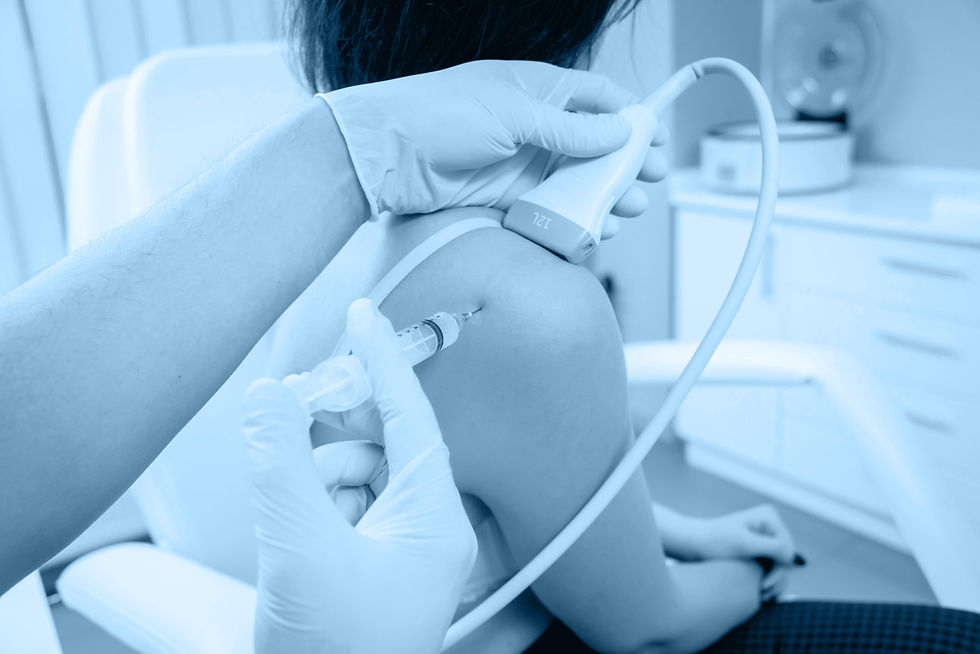
Image-Guided & Interventional Procedures
Selected patients may be candidates for an image-guided or other interventional procedure when the diagnosis and current evidence support its use.
The appropriate procedure depends on the specific source of symptoms.
A procedure should not be selected simply because a patient has “back pain” or “joint pain.”
Potential interventional options within PM&R can include procedures directed toward specific spinal, peripheral nerve, joint, or soft-tissue conditions.
The expected benefit, limitations, risks, and alternatives should be discussed before any procedure is performed.
Current procedure availability at Arthritis & Sports may vary based on the physician and service.
Epidural Steroid Injections
Epidural steroid injections may sometimes be considered for selected patients with radicular pain associated with an irritated spinal nerve.
They are not a general treatment for every type of neck or lower-back pain.
The goal is typically temporary reduction of symptoms so that the patient can improve function or participate more comfortably in rehabilitation.
Benefit varies by diagnosis and patient.
Facet & Other Spine Procedures
Certain spinal pain patterns may prompt evaluation of the small facet joints or other structures around the spine.
Diagnostic blocks or other targeted procedures may sometimes be considered after a careful examination and appropriate imaging.
These procedures should be diagnosis-specific rather than part of an automatic series of injections for chronic back or neck pain.
Nerve-Targeted Procedures
Selected pain conditions may involve peripheral sensory nerves.
Depending on the diagnosis, nerve blocks or other nerve-targeted procedures may occasionally be considered.
The purpose and evidence differ substantially by condition.
A procedure that is appropriate for knee-related nerve pain, for example, may have no role in another type of musculoskeletal pain.
How Does PM&R Work With Physical Therapy?
PM&R and physical therapy are related but different.
A PM&R physician is a medical doctor who evaluates the diagnosis, medical factors, neurologic findings, medications, imaging, and potential need for additional testing or procedures.
A physical therapist evaluates and treats movement and functional impairments through rehabilitation.
For many patients, the two disciplines work together.
The physician may determine the diagnosis and overall medical treatment strategy while the physical therapist builds and progresses the rehabilitation program.
Meet our Physical & Occupational Therapy team.
How Does PM&R Work With Orthopaedic Surgery?
Seeing a Rehabilitation Medicine physician does not mean surgery is being ruled out permanently.
The goal is to determine whether the condition can be managed effectively without an operation.
If nonsurgical treatment is appropriate, PM&R can help coordinate that care.
If the evaluation identifies a structural problem that is unlikely to improve adequately without surgery—or if symptoms continue despite appropriate nonsurgical treatment—the patient may be referred to the appropriate orthopaedic surgeon.
Because Arthritis & Sports includes both nonsurgical and surgical orthopedic care, patients can be directed to the appropriate specialist when treatment needs change.
Meet our orthopedic physicians.
When Should You Consider a Rehabilitation Medicine Evaluation?
A PM&R evaluation may be useful when:
musculoskeletal pain continues despite basic treatment;
neck or back pain repeatedly interferes with everyday activities;
pain travels into an arm or leg;
numbness, tingling, or weakness suggests a nerve problem;
imaging findings do not clearly explain your symptoms;
you want to explore appropriate nonsurgical options;
physical therapy progress has plateaued and the diagnosis needs reassessment;
or a coordinated rehabilitation plan is needed after an injury or chronic condition.
You do not need to know which procedure or test you need before being evaluated.
The first step is determining what is causing the problem.
When Should Symptoms Be Evaluated Urgently?
Certain neurologic or spine-related symptoms require prompt medical attention.
Seek urgent evaluation for:
rapidly progressive weakness;
new loss of bladder or bowel control;
numbness around the groin or saddle area;
significant trauma;
severe or rapidly worsening neurologic symptoms;
or other concerning changes.
Routine Rehabilitation Medicine appointments should not delay emergency evaluation when serious neurologic symptoms are present.
Rehabilitation Medicine in Sterling & South Riding, Virginia
Arthritis & Sports integrates orthopedic care and physical rehabilitation at locations in Sterling and South Riding, Virginia.
Our practice serves patients throughout Loudoun County and Northern Virginia, including Sterling, Ashburn, Leesburg, Reston, Herndon, Chantilly, South Riding, Aldie, and surrounding communities.
Rehabilitation Medicine services and specific interventional procedures may vary based on current provider availability.
Contact our office to confirm current PM&R scheduling and available services.
Visit our South Riding location.
Frequently Asked Questions About Rehabilitation Medicine
What does PM&R stand for?
PM&R stands for Physical Medicine and Rehabilitation. Te specialty is also called physiatry or rehabilitation medicine. Physicians trained in PM&R are known as physiatrists.
Is a physiatrist the same as a physical therapist?
No. A physiatrist is a medical doctor specializing in Physical Medicine and Rehabilitation. A physical therapist is a licensed rehabilitation professional specializing in movement and function. The two may work together as part of the same treatment plan.
Is a physiatrist a pain-management doctor?
PM&R physicians often treat conditions that cause pain, but the specialty is broader than pain management. Physiatrists focus on diagnosis, function, mobility, and rehabilitation. Some PM&R physicians also have additional training in interventional spine care or pain medicine.
Does seeing a physiatrist mean I need an injection?
No. Many PM&R treatment plans involve physical therapy, exercise, activity modification, medication, or other nonsurgical care without an injection. Procedures are considered only when they are appropriate for the diagnosis.
Does PM&R treat back and neck pain?
Yes. Outpatient physiatrists commonly evaluate nonsurgical spine conditions, including neck and back pain and selected nerve-related symptoms. For detailed information about individual spine conditions, see our dedicated neck and back pain resource. Learn more about neck and back pain care.
Can a physiatrist order an EMG?
Physiatrists commonly use electrodiagnostic medicine as part of evaluating selected nerve and muscle conditions when they have appropriate training. EMG and nerve conduction studies can help distinguish certain peripheral nerve, nerve-root, and muscle problems. Learn more about EMG and nerve conduction testing.
Can Rehabilitation Medicine help me avoid surgery?
Sometimes. Many musculoskeletal and spine conditions can be successfully managed without surgery. However, avoiding surgery should not be the goal when a structural problem is unlikely to improve adequately without an operation. The goal is to choose the treatment that best fits the diagnosis.
Do I need a referral to see a PM&R physician?
Referral requirements depend on your insurance plan and the service being scheduled. Some plans may require a referral or authorization. Contact your insurance carrier or Arthritis & Sports if you are unsure about your specific requirements.
Contact Us About Rehabilitation Medicine
If musculoskeletal pain, nerve symptoms, or a spine-related problem is limiting your mobility or everyday activities, a Rehabilitation Medicine evaluation may help clarify the diagnosis and nonsurgical treatment options.
You do not need to decide in advance whether you need physical therapy, an EMG, an injection, or another procedure.
The first step is determining what is causing your symptoms and which treatment approach is appropriate.


